
Transfer dies for large automotive parts
Transfer dies for large structural and body parts: rails, reinforcements, pillars, cross members. Transfer motion simulated before the die is built.
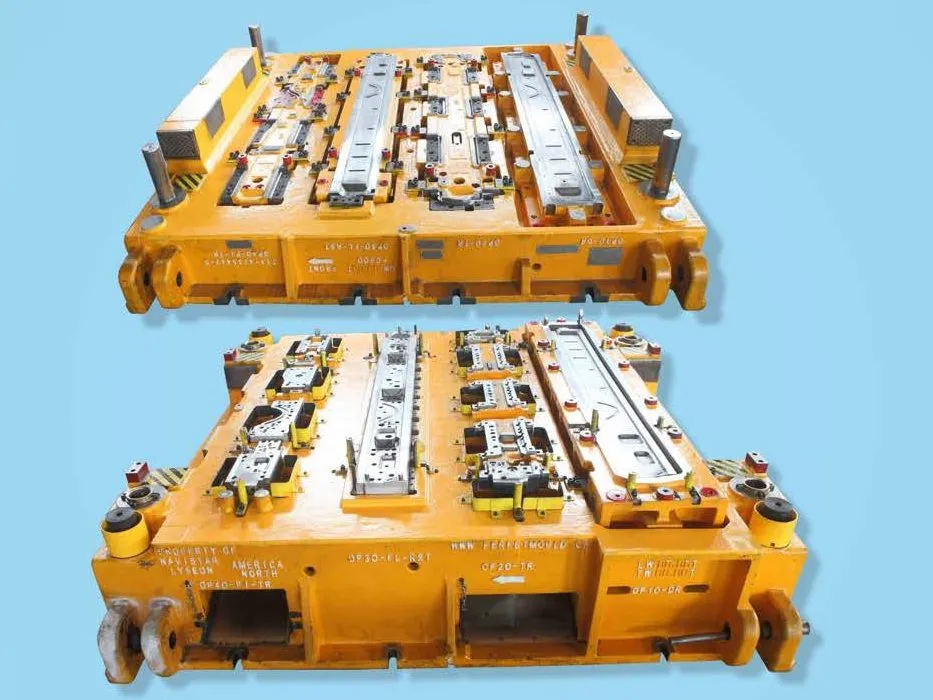
How a transfer die works
A transfer die performs several operations on separate stations within one press. The blank is cut first, then the press transfer fingers move the part from station to station: draw, trim, pierce, flange, restrike. Each station can work the part in a different position.
Parts suited to transfer dies
Transfer is the right choice for parts too large or too deep to stay attached to a carrier strip: rails, reinforcements, pillars, cross members, floor and body-side components. It also allows the part to be turned or tilted between operations.
Transfer motion simulated upfront
Before the die is built, we simulate the transfer motion with your press and transfer data: finger pick-up, trajectories, interference risks and stroke rate. Problems are solved in the design office rather than on the press.
Construction and tryout
Large transfer dies are built on cast iron bases and blocks, with hardened steel inserts and punches on the working surfaces. Each die is tried out in our plants on presses up to 3,200 t, then measured until buy-off. A checking fixture is delivered with every die.
Frequently asked questions
Can you simulate the transfer on our press?
Yes. We need your press and transfer specifications to simulate the real motion.
What size of part can you handle?
It depends on your target press. Our presses go up to 3,200 t. Send us your part and press data and we will confirm.
A project in mind?
Dies, a turnkey line or series production: tell us about your project and we will get back to you.